
Perhaps the most difficult part of being a geophysicist, is explaining what a geophysicist is. It sounds complicated. It’s even hard to say. So… what is a geophysicist?
To children, I like to say that a geophysicist is a person who makes pictures of the world underground; of places that we would not otherwise be able to see. To a more mature audience, I describe it like being an x-ray technologist or sonographer (ultrasound professional) for the earth. While people in these jobs would be looking for contrasts in bone and tissue to signal abnormalities, breaks, or new life, a geophysicist is using images of the earth to look for changes in the rock that might signal water, energy sources, metals, structures like faults or temperature changes in the rocks beneath our feet.
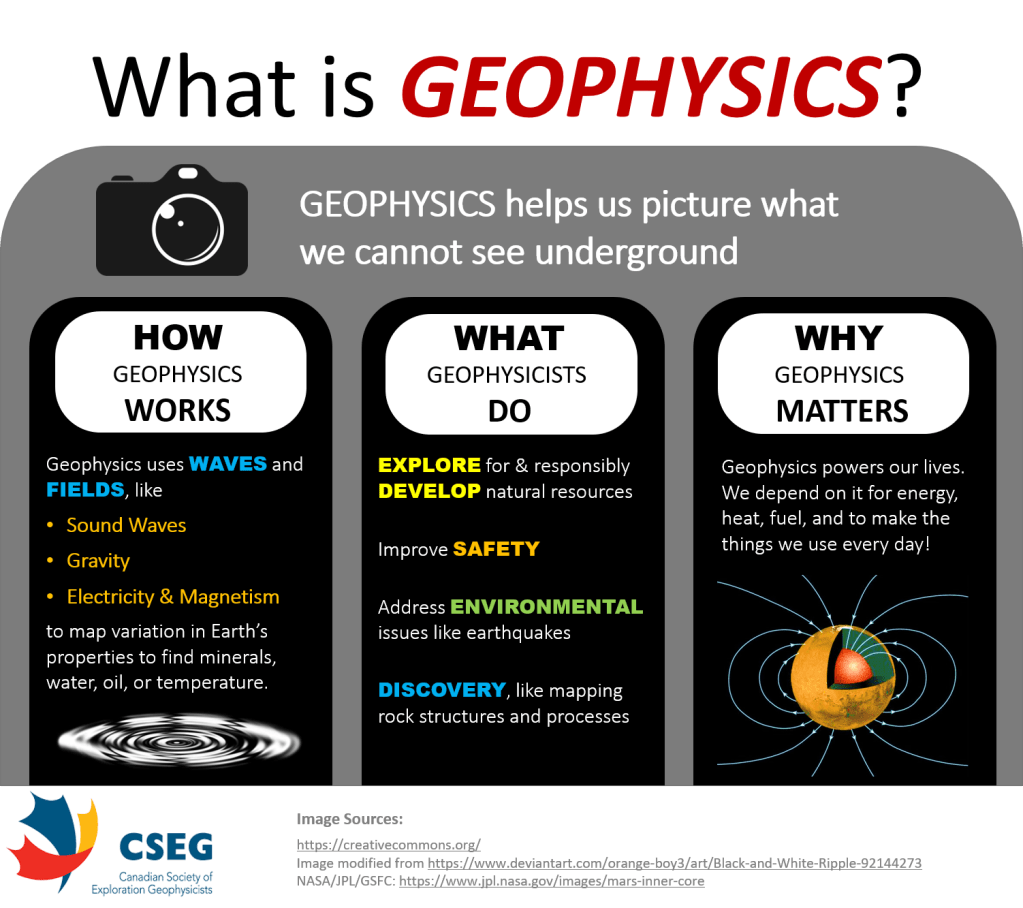
With geophysics we can see ancient meandering rivers, beaches, impact craters from meteorites, faults and folds in the rock, and giant domes of salt rising like air balloons through rock. We can picture what the earth looked like thousands, or many millions of years ago. We can look at how the earth has gradually changed. Looking at a geophysical image is like looking at a slice of history.
How do geophysicists do this? Instead of radiation and ultrasound waves, they use sound waves and magnetic, electric, and gravitational fields to find changes in physical rock properties, like density or conductivity for example, and use these changes to make images of the earth.
Some real-world examples of geophysics in action are:
- Recording earthquake shockwaves to map faults for improved safety
- Looking for changes in aeromagnetic data (magnetic field surveys done from the air) to signal hot areas for geothermal development
- Using ground penetrating radar to identify shallow voids in archaeology (see my previous post)
- Guiding the drilling of wellbores for responsible petroleum or helium extraction
- Evaluation of potential long-term storage sites for carbon dioxide or nuclear waste
Geophysics is both beautiful and practical. It will be a science that will be critical to future energy and resource development. For more information on geophysics or careers in geophysics, check out the Canadian Society of Exploration Geophysicists (CSEG). The CSEG offers a mentorship program for anyone interested in the science as well as free access to their publications and teaching resources.
Other resources and upcoming events:
- Earth Science for Society (Next event in spring 2022)
- APEGA Rock and Fossil Clinic (Next event Oct. 16-23, 2021)
Have questions for a geophysicist? Ask away!
 Energy Rocks